
I used to float, now I just fall down
I used to know but I'm not sure now
What I was made for?
The haunting theme from the 2023 movie Barbie asks the question, What was I made for? In the movie, Stereotypical Barbie is experiencing an existential crisis and emotional transition toward becoming human.
As we begin Rosh Hashanah, which celebrates the creation of humanity, it is hard to let this moment pass us by without reflecting on what this actually means as we consider what it means to become human.
What are we created for?
Who are we to become?
I am certainly thinking about this at this moment-I am Starting year 15 as your Rabbi at SPS, I am turning 50 this year, and Rabbi Dave and I have just become empty nesters. When I started at SPS, the boys were 4 and 6… WOW….
So there is no question that this is a season of change, and it is at these moments, these moments of transition, where we take time to stop, reflect, and think about what we are made for and to whom are we in service of?
Bruce Feiler, in his book Life is In the Transitions, notes two different types of life transitions. The large ones he calls Life Quakes, a massive source of change that lasts for years - a divorce, the death of a loved one, the loss of a job. The others he calls Disruptors. Disruptors are value neutral: some are negative and some are positive. These might include starting a new job, starting a new school, getting married or getting sober or retiring. Becoming an empty nester is part of this.
My colleague, Rabbi Daniel Gropper reflects on this by saying-When a couple gets married, the future is pregnant - sometimes literally - with possibility. They cross the threshold of their home ready to build a new life together. So much awaits them.
What of a couple, married almost 30 years, who return home to a nest that is emptier.
The key to moving through a life disruptor or life quake is to first acknowledge and name it. It includes what Feiler calls “The Long Goodbye,” where you mourn the old life; “The Messy Middle,” which is a time of confusion, experimentation and growth; and “The New Beginning,” that phase of creating and embracing a new identity. Just naming it helps you gain control and clarity.
But to get through any of this, we need to ask the essential questions, why am I here? What does it mean to be human? Or, as the song asked, “what was I made for?”
I spent 8 days this past summer in Jerusalem at the Shalom Hartman Institute where the theme was Being Human-
Dr Yehuda Kurtzer, the co-President of the institution, taught us about how the beginning of the book of Genesis, the story of creation, grapples with what it means to be a human being buy reflecting on two different names for the newly created human.
Kurtzer starts with Adam, and reminds us that Adam represents a being that can exercise power. Why? Because Adam is created betzelem elohim, in God’s image and so it is telling a story of massive human power of potential - but don’t be surprised that human beings try to act like God if this is what we are set up to do….and then there are challenges, so we need to always figure out how to temper that. So as Kurtzer said, -the Adam is the earthly shell infused w/power and responsibility
The story of Genesis 2-is also oriented around the creation of the human but in a very different way. Here it is about responsibility, not just power, because in the second telling of the creation story, we see that there is a second human being introduced-we meet not just the ISH, the man, but the ISHA, the woman. Which means, that there are two people in relationship to each other. It isn’t like the first chapter where it is about Adam’s abilities vis a vis God and the understanding of responsibility in the world, the ish, this new being, -is in a horizontal relationship with Isha-a social relationship-teaching that the primary responsibility is with other people.
So we have both vertical and horizontal axis on which we exist and so the question is, if our origin permits us to think about the tremendous potential that we have, how will we use it?
How do we find out who we are and who we are destined to become?
How do we become the best human versions of ourselves?
Rabbi Donniel Hartman, the other co-president of Hartman taught us that
Our tradition sets the bar impossibly high to be a human being-
As he reminds us, throughout the book of Leviticus, we are told that Kedoshim Tihyu, you, humanity will be holy b/c I God am holy. So as Hartman says,
What defines our greatness is not merely that we will exist but what we will become.
In the middle ages, the essence of the human being was seen through our intellectual capacity
But it isn’t only about intellect.
The Babylonian Talmud reminds us that if we are created in the image of God in Genesis, and if Deuteronomy commands us to “walk after God,” then we are called to imitate God’s attributes.
We should clothe the naked.
We should visit the sick.
We should console mourners.
We should bury the dead.
The bottom line is this:
We are created to be a mensch.
That is an aspirational statement. It isn’t about what you know. It is about what you do.
It is about how you behave. It is about whether you act with decency and compassion.
The prophet Micah makes this even more explicit when he asks “What does God seek from us?”
To do justice.
To love goodness.
And to walk humbly with God.
For Micah, this is not simply an aspiration. It is an obligation.
So, can I be worthy of being created in the image of God? Yes.
The moral aspiration is yes you can.
So where does that leave us?
To the pathway of service to find the intersection between the ADAM and the ISH, and where do we find that? At Avodah.
It is a word we will build toward throughout these High Holidays, culminating on Yom Kippur with the Avodah service. Avodah-worship and service. Two essential actions.
So perhaps the question is not only:
Who am I?
It is also:
What does it mean for me to serve?
Maybe, as we live, grow, and are in relationship, we serve God by how we treat others?
Maybe, as we live, grow, and are in relationship, we serve people through our dedication, ideas, and commitments
Maybe, as we live, grow, and are in relationship, we serve our community through our volunteering and our willingness to show up
Maybe, as we live, grow, and are in relationship, we serve our country through our patriotism, civic engagement, and the understanding that we are a part of a much greater whole.
Today is September 11th, the 25th anniversary of the horrific attacks on our country, and our city in particular, a day that both stood still, and changed our world forever. The people who were murdered that day should be remembered for all that they were and even who they might have been. When I think about the first responders, who ran into save lives and who never came out, or those who came out but became ill, I think of the service that they gave for something greater than themselves. At that moment, they reflected the best of humanity, at a moment where others were displaying the worst. We pause and we remember them for their service and their sacrifice and for reminding us what it means to be human.
So how do we get to where we want to be? We begin with the end in mind, for as proverbs teaches, those without vision, perish.
Melissa Kirsch, in an article on FUTURE PERFECT, writes about our future selves.
She shares a reflection “backer-inners”:
“Once you see it, you can’t unsee it,” her colleague Steven Kurutz said. He was talking about the phenomenon of people increasingly backing their cars into parking spots, the subject of his recent investigation. “Fifteen or 20 years ago, it seemed that everyone parked the same way,” he said. …Backing in makes it easier to get out. “You’re going to back up coming or going,” Steven wrote. “Backer-inners, it seemed, preferred doing the harder maneuver first.”
The backer-inners are thinking about their future selves, performing the fussier parking job now so that Future Them can reap the benefits of getting on the road faster.
Kirsch continues-It can feel like a drag to do something uncomfortable now in order to reap the benefits later — see: saving for retirement, going to the gym. In some cases, the future payoff feels worth it; in others, not so much. As she wrote: No matter how much I’d prefer to leave it for morning, I load the dishwasher, wipe down the counters, arrange the pillows on the couch so that Future Me will wake up to a scene of order. I know Future Me, and she finds starting the day with a mess of dirty dishes a total bummer. I love this idea because it asks us to think not only about who we are today but who we are becoming.
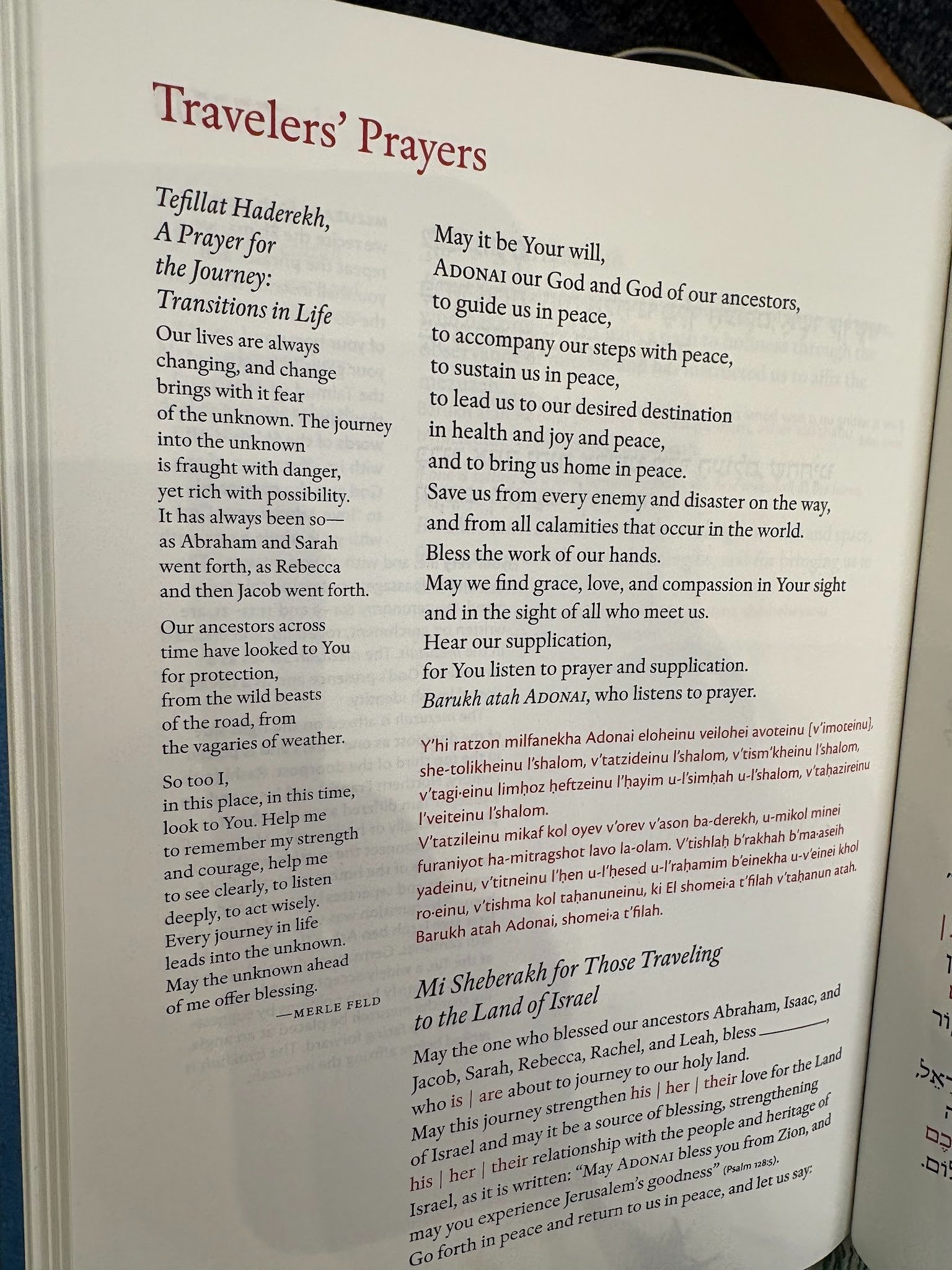
In my upcoming book that I am excited to share with you, I focus on each of our life’s journeys with a sense of purpose, by understanding how our Jewish tradition can answer the everyday and the existential question. But the title, Watch How You Go: Jewish Wisdom For Your Journey Ahead, is proscriptive, as it reminds us, the best way to be in life, is always to be on a journey of discovery. We won’t always know who we will become but Judaism gives us the tools to keep asking the question, for standing still will set us backwards.
.
So, as we journey through life, into whatever stage we are entering, the goal of being human is to do it in a way where we understand that we are the best versions of ourselves, when we can be proud of our relationships with others, God and humanity alike, when we are showing dedication and commitment to our community, and doing our best to make the world better for tomorrow.
We don’t know we will become but we know that Rosh Hashanah gives us the opportunity to discover, renewed, who we want to be.
So, as we begin this new year, allow me to offer this prayer from our siddur for each of us, for all of us…because we are all on a journey as the year begins anew.